

The smartest moment in Schmooze’s video for “Too Late to Plead Insanity” arrives after the gun pointed toward the camera, the stark performance shots, and the flashes of the band playing live.
One by one, the musicians stop.
The instruments are placed on the floor. Jack Weatherby leaves his guitar lying across the pedals, still feeding distortion into the emptying room. Eventually, vocalist Cameryn Carr is the only person left standing. Then she drops the microphone.
It is not the triumphant mic drop people use after winning an argument online. It feels closer to abandonment, as though the song has slowly removed every support holding her upright and finally decided to leave her there.
For a track called “Too Late to Plead Insanity,” that is a better ending than another dramatic performance pose could have provided.
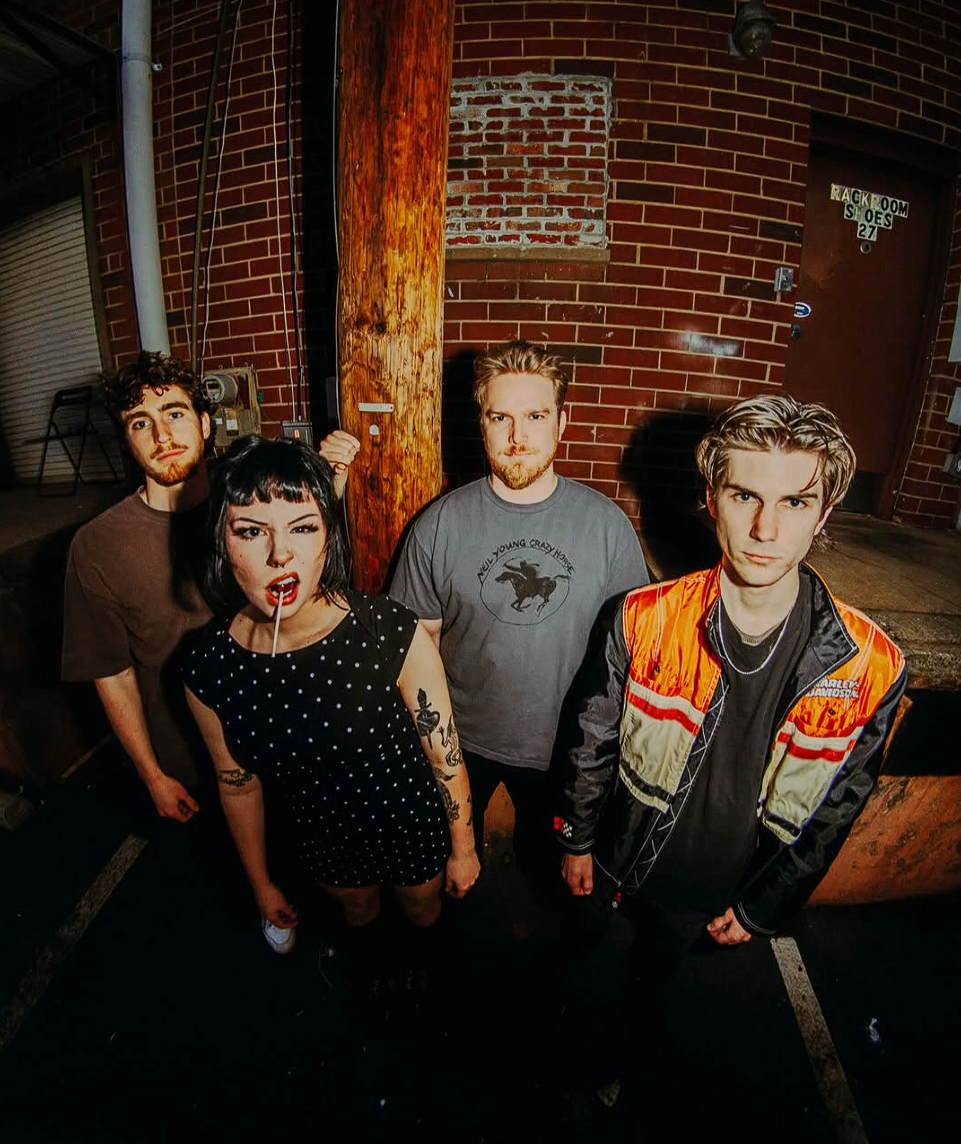
The single originally arrived on November 7, 2025, before the music video followed in May 2026. Schmooze’s current lineup features Carr on vocals, Weatherby on lead guitar, Colin Thomasson on bass, and Dallas Wiggins on drums. Their AthFest profile describes the Athens band as a collision of ’90s grunge, modern punk, and indie rock, which is accurate enough as a starting point. “Too Late to Plead Insanity” becomes more interesting once it starts slipping outside those borders.
The bass is allowed out of the basement
The Ferg’s comparison to Sonic Youth and the Breeders makes immediate sense. The song carries the looseness and abrasion associated with ’90s alternative rock, but Schmooze do not spend four and a half minutes performing historical reenactment in thrift-store denim.
The melodic guitar provides the thread, while the arrangement keeps tightening and releasing around it. Each approach toward the chorus grows heavier, but the song avoids turning that escalation into the usual quiet-loud-quiet assembly line.
The bass deserves particular attention because it is permitted to behave like an actual instrument.
Rock production has a strange habit of treating bass as structural plumbing. Everyone agrees it is necessary, but nobody wants to see or hear too much of it. On “Too Late to Plead Insanity,” Thomasson’s playing remains prominent enough to affect the character of the song rather than merely preventing the floor from collapsing.
After Weatherby’s guitar solo, the rhythm section receives room to pull the track somewhere less predictable. The song slows, loosens, and briefly takes on the feel of a band discovering jazz in the middle of an emotional emergency.
That turn is not technically tidy, which is why it works. Schmooze allow the song to change its posture without stopping to explain the new seating arrangement.
A voice that changes with the room
Carr’s vocal performance has to move with all of those shifts.
She is not simply asked to sing louder as the instrumentation grows heavier. Her delivery changes with the song’s mood, carrying melody through the quieter passages before meeting the harsher sections without being flattened by them.
That distinction matters. A powerful vocalist can easily become the only thing anyone discusses about a band, especially when the rest of the music is treated as an attractively noisy platform underneath them. Schmooze avoid that imbalance. Carr commands the song, but the instruments keep giving her different surfaces to push against.
The Ferg singled out one lyric in particular:
“Take your time to understand me. Close your eyes.”
It reads like an invitation until the rest of the song makes it feel more like a warning.
That tension suits Carr’s performance. The vocal is melodic without becoming comforting, expressive without spilling every emotion onto the floor in labeled containers. She sounds most effective when the song leaves a little uncertainty around what, exactly, the listener has agreed to understand.
The video knows when to stop performing
The official video was created by Apartment 1 Productions, directed by José Nava and Emma Husk, and produced by Carr. It moves through graffiti-covered interiors, an old theater, exterior locations, live footage, and the cleaner white-backdrop performance setup before allowing those separate images to collapse into the final departure.
The mixture could have become a portfolio reel for every location the production could access. Instead, the editing gives the contrast a purpose.
The live footage shows Schmooze as a functioning, energetic unit. The theatrical spaces make the song feel larger and stranger. The white backdrop strips away that atmosphere until the viewer is left watching the members remove themselves from the performance.
By the time Weatherby abandons the distorted guitar and Carr drops the mic, the video has turned the band’s disappearance into part of the arrangement.
Plenty of music videos end with everyone still playing at maximum intensity because nobody knows what else to do during the final chorus. Schmooze make absence the final visual.
It is considerably harder to forget.
The verdict
“Too Late to Plead Insanity” is not valuable because it proves Schmooze have listened to the correct ’90s records. Athens has never suffered from a shortage of bands with strong opinions about guitar tone.
The single works because Schmooze use that history as raw material rather than a dress code.
The guitar sings without swallowing the track. The bass refuses to disappear. Carr’s voice changes shape with the arrangement, and the rhythm section guides the song into a late passage that feels unstable in the right ways. The video then understands the assignment well enough to stop adding things and begin taking them away.
There are moments when the song’s influences remain clearly visible, but Schmooze are already developing the more important quality: an instinct for when a familiar structure should be interrupted.
“Too Late to Plead Insanity” begins as a convincing alternative-rock song.
It ends as a small crime scene.
Watch the official music video, stream “Too Late to Plead Insanity”, and follow Schmooze on Instagram for new music and live dates.